
From Boston, Inspired by German Expressionism
For Boston-native Ibrahim Ali-Salaam, (b. Boston, 1976) capturing what he knows and loves is second nature. Hailing from a large family, and a father himself, Ali-Salaam is a keen observer and chronicler of those around him. Steeped in anatomical exactitude at the School of Museum of Fine Arts of the late 1990s and early turn of the century, and inspired by classical sculpture, and German expressionism, Ali-Salaam’s figurative artwork focuses on unique depictions of everyday moments from his personal life and interior narrative.
Everyday Subjects, Subtle Symbolism
Focusing on family, friends and self-portraits, Ibrahim Ali-Salaam’s paintings honor daily life, rather than exceptional experiences. The artist wields his particular perspective, placing figures on the canvas with symbolic intent, or crooking an elbow or curling a finger just so. His finesse of the formal features of his work becomes the subtle symbolism to read and decipher the layered meaning of his work.
Inspired by his son
While Ibrahim Ali-Salaam’s family network is rich with inspiration, his son is one of his most frequent muses. His Beautiful Little Monster series has featured his son, Joaquin, over a number of years, starting in toddlerhood.
Artist Inspiration: Parenthood
Tracking his development, Ali-Salaam started by reproducing his son’s drawings as part of a larger portrait. Over time, the works shifted experimentally to active collaborations as his son grew. This ongoing series captures a thematic narrative arc indicative of his work: a family member featured, in a relatively mundane pose representative of relationship to the artist or their stage in life. Often, given the artist’s great love of Egon Schiele, hands or feet are often used to reinforce emotion, and his symbolic message.

Formal Analysis - Beautiful Little Monster #2
In the Beautiful Little Monster series, the second piece (Beautiful Little Monster #2 oil, chalk, pastel on panel, 2018, 45 x 45 in. figure 1) honors his son around age 6. The viewer is situated over the child’s left shoulder, watching as the little boy contemplates his artwork on a chalk wall. With folded legs, one hand tucked towards his chest and the other extended, the child considers what to do next, balanced between contemplation and action.
Capturing meaning in a gesture
Centered on a wall of ghostly erasures and diminutive figures, the child's poised hand suggests a sense of consideration, and anticipated action. The tension is palpable and remains a strength of this artwork. It captures both the potential of what may be drawn next, and implies the larger question of the future to come for the child.
Artistic Symbolism: Parkinson's Caregiver
This sense of anticipating action, or stalled/frozen action, is at the heart of many symbolic compositions. Another example, taken from the opposite end of the age spectrum is in Ali-Salaam’s series about his father, Muhammad Ali-Salaam. Until early 2024 the artist worked as one of his father’s caretakers, observing his father, a stalwart of Boston’s Islamic community, slowly succumb to dementia with Lewey Bodies over multiple years.
A snapshot
What appears on the canvas suggests that the artwork reflects a form of symbolic expression and processing. This monochromatic work (in a hue reminiscent of hospital scrubs), Doing His Best, Looking His Best, (44 ½ x 57 in., mixed media on canvas, 2024) is a snapshot portrait of his father in his last year of life.
Formal analysis of Doing His Best, Looking His Best
The large painting features Muhammad Ali-Salaam having his hair trimmed by his son, Saladin. His diminutive form is almost entirely swallowed by the cape draped over him. The two figures - the standing figure and the artist’s sitting father - fill the left-hand side of the canvas, but the right side remains empty. No background tethers the two figures. Rather, they float in a sea of teal, untethered except for the edges of the painting, which cut them off at the head and feet, and the clippers, with their umbilical-like cord wrapped trailing into the distance.

Presenting a figure symbolically on canvas
The artist’s father sits at a three-quarter view, facing both out towards the audience, slightly down, and also towards the empty canvas. Only the legs of the chair give viewers the sense of depth, gravity or angle. With death the only inevitable outcome of this illness, a lack of grounding is natural. The artist’s father sits. Only a head and wrinkled brow offer any semblance of his identity. With no hands for making and no feet for movement, a literal lack of agency in the real world appears here as invisible hands and cut off feet.
Emotional connections
The seemingly simple presentation of this piece is a testament to Ali-Salaam’s visual expression of grief through his symbolic composition. This simple, flat composition, and the emptiness it implies, sits in stark contrast to other paintings the artist has completed both before and after the months in extremis caretaking his dying father.
Caretaking oneself and others
The piece above shares a common thread with the two below: Try’na Catch a Wave, (oil on canvas, 36 x 36, 2025) or How We Live it, Spirits Visit (oil on canvas, 20 x 20 in., 2022). They also revolve around male haircare. All three also subtly allude to care and protection, as the two below portray the use of a du-rag (used to protect and care for one’s hair), and the braiding or un-braiding of a person’s hair into cornrows, a protective style. However, both also project a dimensionality absent from Doing His Best.

Quiet, noble, moments
Like Doing His Best these pieces also lack backgrounds. However Ali-Salaam pivots his painting style from a matte monochrome to lush warm hues to evoke a sense of honor and pride in these small moments. He infuses the pieces with texture and color, creating dimensionality on the canvas.

Colors and figures
A sunset wash glows behind the figure tying his durag in Try’na Catch a Wave, and warm hues dapple the canvas in How We Live it, Spirits Visit. The two figures also strike classical-inspired poses: the first, with arms up, in a pose one imagines from a life drawing class, with defined and articulated limbs and hands.
Connections to art history
The second figure, likely seated, given that other person’s hands seem to hover above, is having his hair braided. Half his head is finished into neat corn rows. The other half remains to be done and puffs out above his skull and the comb tucked in. From his chin all the way back to the braider’s comb, light and texture radiates out from all facets of the figure’s profile, alluding to the halos of Christianity and medieval and renaissance artwork.
Mindfulness of the beauty of a moment
Both paintings elevate a mere moment of caring for one’s hair (at one’s own hands or in the hands’ of others) and elevate it in multiple ways: by memorializing it as a painting, using bright hues and dramatic gestural impasto (brushmarks on the canvas), and with the marks of self-care in the use of a du-rag (used to protect and care for one’s hair), and having someone braid or un-braid another’s hair into cornrows, a protective style.
A simple gesture as fine art
Ali-Salaam isolates and distills a single moment of daily life into a uniquely interpreted work of art. In so doing, he highlights how to appreciate that instant. He memorializes and elevates the tension and emotion through the human figure, and often through their gesture, subtly alluding to the promise they hold: whether it be anticipation, tenderness, pride, or grief. Ali-Salaam captures what appears mundane, but upon closer inspection is anything but ordinary.
Documenting quiet moments
Ali-Salaam’s work takes these intimate moments, and shares them with an audience. The framing of the work suggests intimacy. From a father looking over the shoulder of his child, to the intimacy of a son cutting his father’s hair, these are not pieces documenting momentous moments in history, nor with the intention of presenting a public persona. Rather, they honor quiet moments.
The intimacy of looking down a woman’s dress
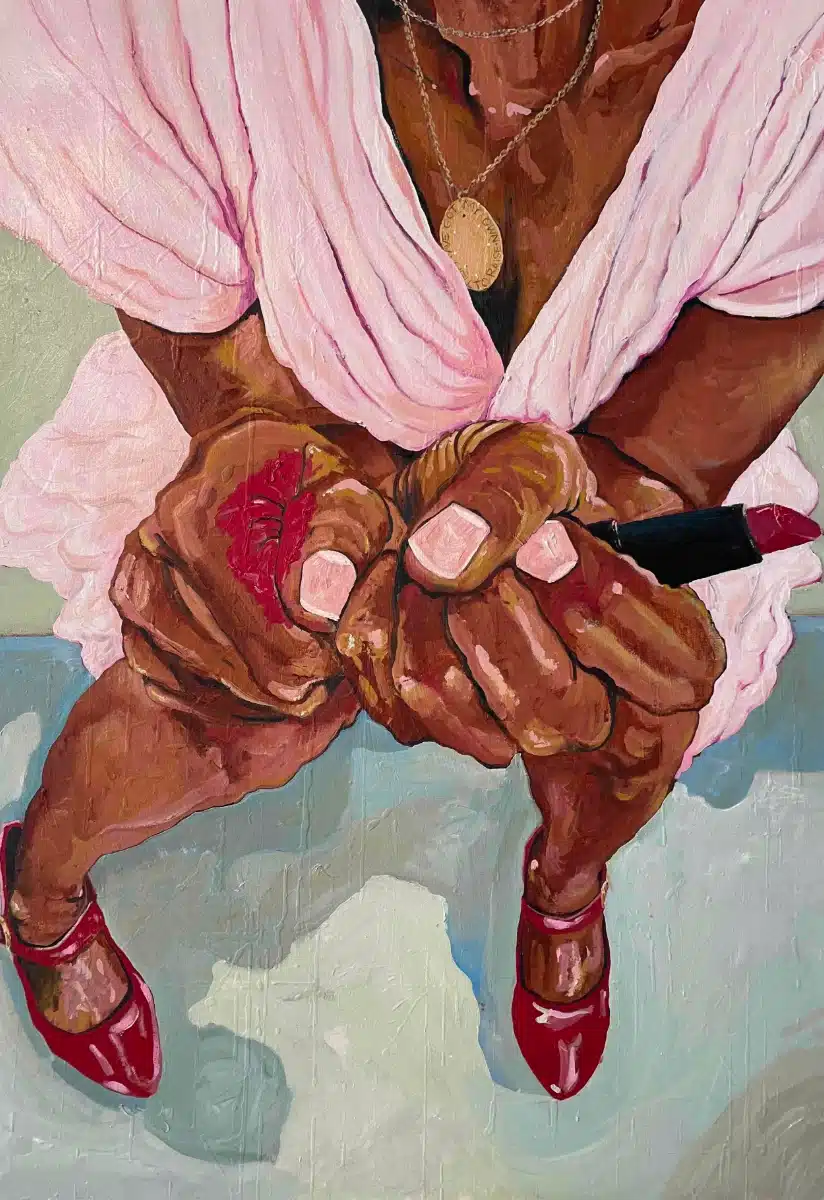
An example of a quiet intimate moment is found in My Own Hell To Raise. (oil on canvas, 45.5 x 32 in., 2025). This playful piece features the figure of a woman and a tube of lipstick. It takes an intimate and up close perspective. The framing also reinforces how Ali-Salaam’s framing and position work to evoke particular feelings in his viewers. In this piece, the viewer is put into close contact with the figure, one cannot help but feel a sense of either familiarity, or dominance as the viewer is positioned to look down at the subject from above, virtually seeing right down the front of her dress. Here, the viewer virtually becomes the artist, standing in his metaphorical shoes as he stands in front of the woman depicted. Clearly this is a piece meant to memorialize a moment rather than a message or historic occurrence to share with a large audience.
A reminder for mindfulness
As Ali-Salaam elevates everyday moments to a space of honor for his subjects, formal elements contribute to the artist’s symbolic end result. Ali-Salaam’s scenes capture the everyday with subtle emotional cadence that leaves an indelible impression upon the viewer. His eye appreciates relationships and emotion, and particularly how we use and portray ourselves through the physical form. Ali-Salaam’s deft use of color, position and layout in the formal aspects of his paintings reinforces the emotions he skillfully evokes and the moments in time he memorializes.
Ali-Salaam: a Mindful Painter
The uniqueness of Ibrahim Ali-Salaam is that he recognizes the beauty in the small moments. He not only sees them, but then photographs them, and reproduces them for us all to appreciate.
His artwork holds a deeper message, a key that unlocks one of life’s great secrets: that our ultimate emotional state of being is found in being mindful of the small moments, not the big ones. Life is filled with large, memorable events. Those photographs, we all have thousands of, on our cameras. It’s easy to glide through life without taking note of the beauty in the small moments of beauty we experience everyday, but Ali-Salaam’s paintings offer a reminder that small, meaningful moments exist and are worth celebrating.
Bibliography
- National Gallery of Art, Scotland. (2018, February 8). Children in art | National Galleries of Scotland. https://www.nationalgalleries.org/art-and-artists/features/children-art
- Tate Museum (Ed.). (n.d.). Family and Art. Tate.org. https://www.tate.org.uk/art/family-and-art
- Tsvetkovich, M. (2019, October 28). Small masterpieces: Famous artists paint their children. Arthive. https://arthive.com/publications/2457~Small_Masterpieces_famous_artist_paint_their_children#google_vignette
Image Sources: All images Courtesy of the Artist